


Trident Virtual Command Centre
TVCC is Trusted By
Training Simulators Built For Client Assets
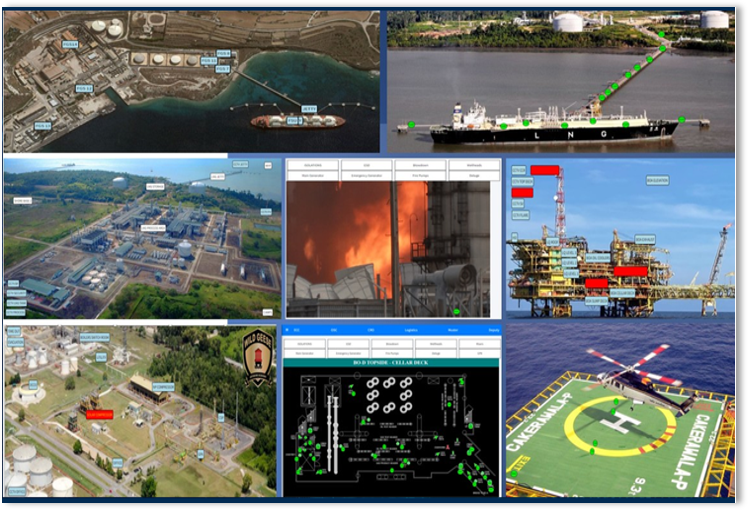
The TRIDENT Virtual Command Centre can be configured to replicate a wide range of onshore and offshore assets, including offshore production installations, drilling units, FPSOs and FLNGs, LNG terminals, refineries, petrochemical plants, power generation facilities, industrial complexes, ports, and national-level command centres.
To date, we have built and delivered over 200 simulator models, each aligned to real asset layouts, Emergency Response Plans, and command structure.
The TVCC has been globally accepted for NOCN and OPITO delivery of emergency management courses.
- Easy Customisation
- Web-based Simulator
- Training on Any Asset
Remote Training Delivery
We recognise that justifying the cost and logistics of travel to international training centres is increasingly challenging. Our remotely delivered training platform enables participants to access high-fidelity training via a secure internet connection, while retaining the realism and effectiveness traditionally associated with on-premise systems. This approach removes the need for travel without compromising learning outcomes.
All simulators are hosted privately by Wild Geese Group private cloud hosted servers at our secure facility, to ensure zero-down time for the end-user.
Students and instructors operate within a fully populated Emergency Command Centre (ECC). All ECC roles are actively managed using role-specific action boards, ensuring realistic command, coordination, and decision-making.
Asset interface dashboards display live process conditions and alarms, including shutdown and blowdown activity, gas leaks, fire, smoke, heat, and fire protection system responses. Scenarios evolve dynamically based on participant actions and can be paused, replayed, or reused for benchmarking and repeat training.
Different asset models can be loaded to support incident and emergency response management training, without changes to the ECC structure or delivery approach.
Covering OPITO Standards Including:
9004: CROER
Control Room Operator - Emergency Response Training
7228: MEMIR
Major Emergency Management - Initial Response Training
7025: OIMCE
Offshore Installation Manager - Controlling Emergencies Training
9030: PMIC IR
Plant Manager/Incident Commander - Initial Response Training
Testimonials
QISC
QISC has utilised the Wild Geese Group TRIDENT Virtual Command Centre (TVCC) emergency simulation platform as its preferred delivery platform for OPITO OIM, MEMIR, and CRO Emergency Response delivery since 2024. The impact on training realism, instructional control, and learner engagement and feedback has been exceptional.
WGG’s TVCC offers a level of interoperability and configurability that we have not seen in any other emergency simulation solution on the market. Unlike other generic simulation tools that only replicate Asset ‘Types’, TVCC enables scenarios to be built to reflect a learner’s ACTUAL ASSET, including layout, imagery, sounds, video files, and organisational interfaces. This significantly enhances training relevance, decision-making realism, and assessment validity.
Einar Johannesson – Business and Operations Manager
Standard & Customized Simulator Models

FPSO
Specialized vessel used in the offshore oil and gas industry to process, store, and offload hydrocarbons directly from subsea wells.
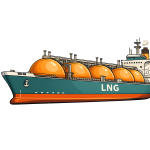
FLNG
Specialized offshore vessels that produce, liquefy, store, and transfer natural gas directly at the site of extraction, eliminating the need for long pipelines to onshore processing plants.

Semi-Sub
Specialized marine vessel or platform designed to operate with its lower hull structures submerged below the water surface for stability

Jack-up & Fixed Production
Specialized offshore drilling rig the legs of which are lowered to the seabed from the operating platform.

Onshore Plant & Refinary
Industrial facility, processing terminal, or production unit situated on land (the mainland)
Each simulator can be customized or changed by the software lease holder to add/remove/ammend:
- Fire, Gas, Heat Detector Locations
- Manually Activated Call-points
- General Purpose Alarms
- PA Systems
- CCTV Animations
- Wide Range of Sound Effects to Support Scenarios
- OIM, Deputy, CRO, Logistics, Logger, and Muster positions.